Blasting cabinets

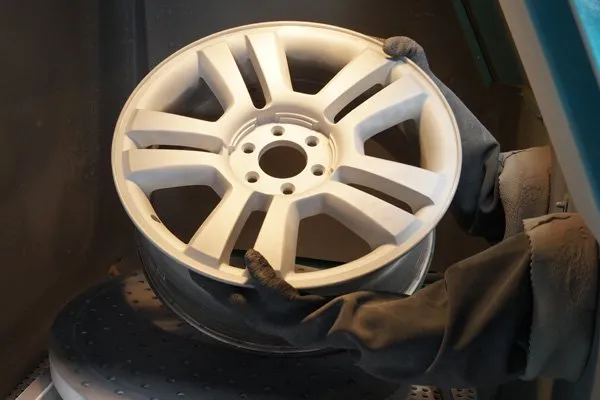
Blasting with recovery: automatic, in a container or by hand.

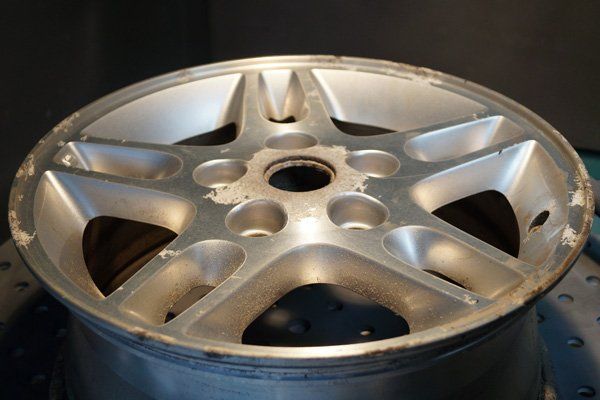
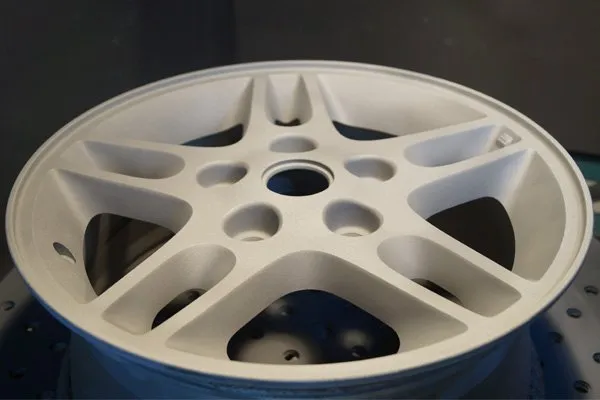
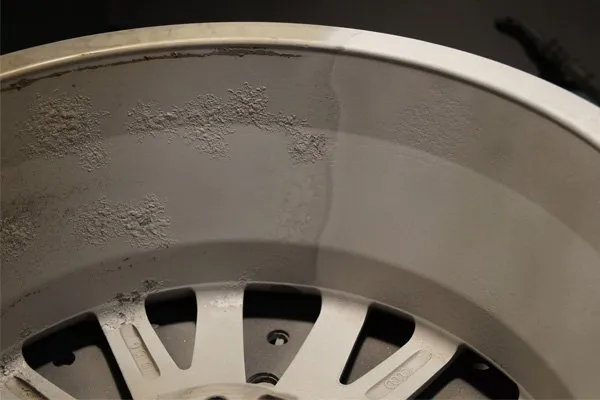
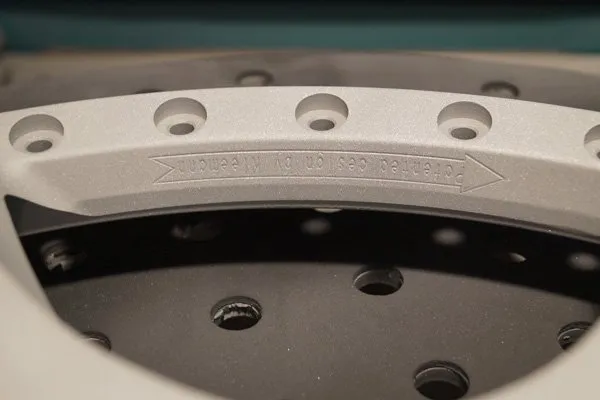
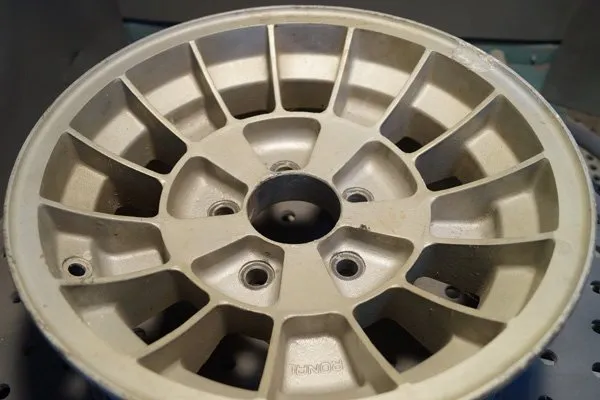
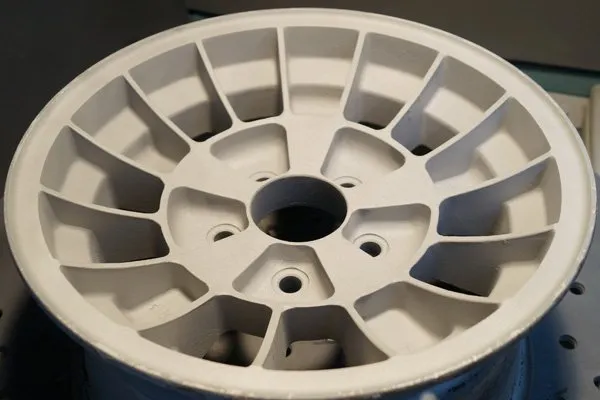
After chemical stripping, the wheel is blasted with corundum or steel shot: for the slight roughness that powder, primer and top coat need for adhesion, and against residues, oxidation and corrosion. Without significant material removal, because the wheel remains a safety component.

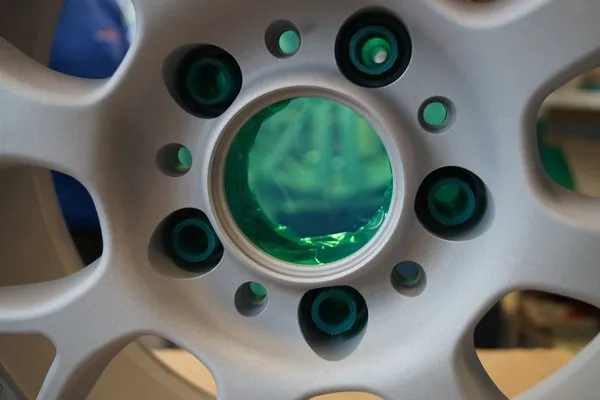
Blasted alloy wheel
  • < 4 minper wheel in the MW-Autoblast W24 II
  • 200×reuse of the blasting media
  • > 30 wheelsper blasting hour in the container

Three designs compared

The systems differ in degree of automation, capacity, and maintenance and wear costs.

SystemDesignWheel size / blasting chamberThroughputSuitable for
MW-Autoblast W24 IIFully automatic blasting cabinetWheels up to 24 inchunder 4 minutes per wheelWheel businesses with high throughput, low staffing
Blasting container MW-10 / MW-20 / MW-40Blasting chamber in container design 10, 20 or 40 ft20 ft: 5,900 × 2,300 × 2,300 mmover 30 wheels per blasting hourBusinesses that blast more than just wheels
Manual blasting cabinet SMG 160D-1703Compact manual cabinetBlasting chamber 1350 × 1100 × 1100 mmmanualEntry level, small quantities, rework

Technical data

Automatic blasting cabinet MW-Autoblast W24 II

Function
Fully automatic blasting; wheels are completely blasted in under 4 minutes (depending on pre-treatment and surface)
Wheel size
Up to 24 inch
Blasting media
Reusable up to 200 times; significantly lower compressed air consumption
Electrical connection
11 kW / 400 V
Protection class
IP54
Noise level
< 85 dB, low maintenance
Dimensions blasting cabinet (L × W × H)
940 × 1150 × 1800 mm
Filter module
510 × 990 × 1700 mm, frequency-controlled filter cleaning
Collection container
Ø 400 mm, height 580 mm
Recommended installation area
5.5 m²
Weight
approx. 850 kg
Colour
RAL 7024
Shop price
€20,900 net (instead of €24,875)

Blasting container MW-10 | MW-20 | MW-40

Construction
Sheet steel container 10, 20 or 40 ft, RAL 7024; box frame profile with welded wall and ceiling panels; floor 8 mm steel
Lining
Specially coated plastic tarpaulin Bisonyl, 670 g/m²
Blasting chamber 20 ft, internal
Length 5,900 mm, width 2,300 mm, height 2,300 mm; loading door 2,300 × 2,280 mm
Lighting
LED with Makrolon cover, 7 × 60 W
Recovery and reconditioning
Sweep hopper or pit, bucket elevator, media cleaner, extraction duct to cartridge filter, media silo; side-mounted, frequency-controlled
Blast pot
Sieve, hopper, dust-tight connection; capacity 200 l; pneumatic remote control; pneumatic metering valve UDV; quick exhaust with silencer; compressed air inlet valve; built to Pressure Equipment Directive 97/23/EC
Cartridge filter unit
Continuous compressed air cleaning via solenoid valves and blow pipes; housing 3 mm steel; frame of square tube and 3 mm sheet
Throughput
Over 30 wheels per blasting hour

Manual blasting cabinet SMG 160D-1703

Blasting chamber (W × D × H)
1350 × 1100 × 1100 mm
Cabinet
Dust-tight negative pressure cabinet in steel; two double-walled, foam-insulated, lockable side doors with electric safety cut-out
Gloves
Special rubber, cotton-lined, fixed to the cabinet
Controls
ON/OFF for extraction and light, pressure regulator, pressure gauge, foot switch
Viewing window
Safety glass 500 × 320 mm, replaceable without tools; LED lighting
Blasting system
High-performance blasting gun system with foot pedal; blow-off nozzles for workpieces; pressure blasting system with various pot sizes incl. recovery
Recovery
Type 255, split, rubberised, coarse sieve with ring magnet; TÜV-tested pressure vessel 100 l, Ø approx. 480 mm, separate from the negative pressure chamber; metering valve and ball valve; storage hopper above the vessel
Fill level information system
Siemens LOGO module evaluates level sensors (dust bucket full, media max., media min.): visual signal and blasting stop
Energy saving function
Separate timers for light (default 5 min) and extraction (10 min), reactivation by foot pedal; opening the door switches the light on
Maintenance
Maintenance indicator lamp flashes after 1,000 operating hours, reset by service

Advantages of recovery: lower consumption, continuous cleaning, separation of coarse dirt and iron, constant media quality, reproducible surface, effective cyclone.


Blasted wheels

Fine blasting as preparation for every coating: oxidation and residual paint are completely removed afterwards.

  • Blasted wheel
  • Blasted wheel
  • Blasted wheel
  • Blasted wheel
  • Blasted wheel
  • Blasted wheel
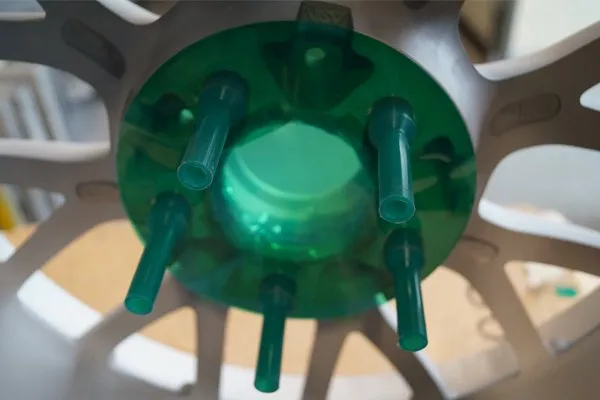
  • Masked wheel before coating
  • Masked wheel before coating

What all three systems have in common

  • High throughput

    Designed for the wheel business, not for occasional blasting.

  • Reduced media consumption

    Recovery and reconditioning keep the blasting media in circulation.

  • Frequency-controlled filter cleaning

    Fewer filter changes, constant extraction capacity.

  • From our own workshop

    All systems also run in our wheel refurbishment in Dietzenbach.

See a blasting cabinet in operation

Demonstration in the demonstration centre in Dietzenbach or quote by phone: +49 (0) 6074 21 50 70.