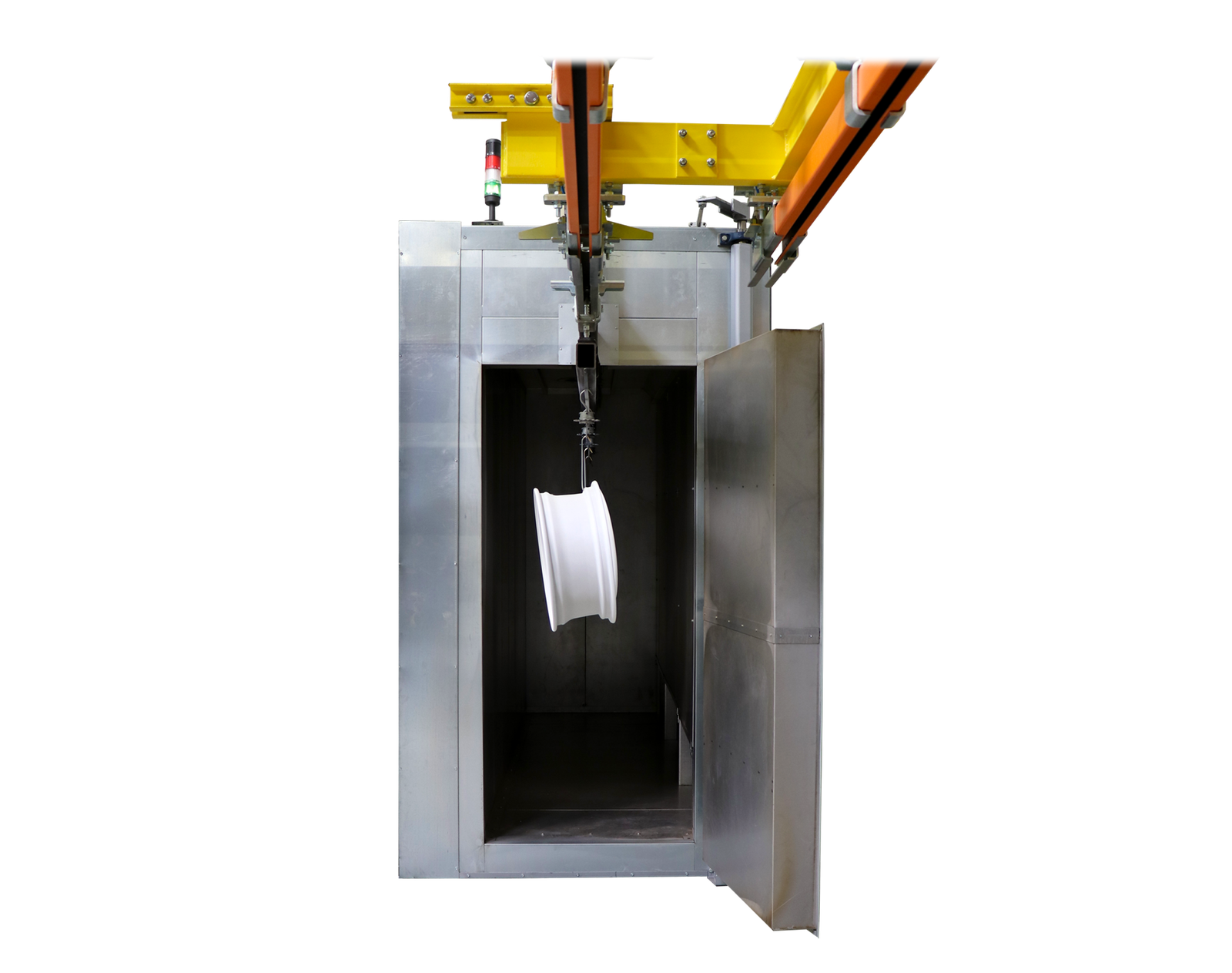
Powder curing oven for wheels

Powder coating lines

Powder coating wheels as in wheel production.

High-quality curing ovens and powder coating stations, optimised for coating wheels. The basic package is fully set up by wheel professionals, including powder training with practical exercises, loaded oven measurement, support, service, maintenance and 24-hour spare parts service.

  • ~40 wheelsper day with the basic system (one shift)
  • < 1 minutecoating time per wheel
  • 1–2 daysuntil staff are ready to work

The plant

The basic package

Powder curing oven, powder booth, Gema manual coating unit and oven trolley. Fully CE compliant, expandable at any time without changing systems.

  • Curing oven (batch oven)

    Designed specifically for the curing process for wheels. Siemens control with exact temperature management (deviation approx. 0.1 °C), hot-dip galvanised, reinforced with profile steel, insulated with 150 mm rock wool.

  • Powder booth

    Extraction capacity 8,000 m³/h, 8-filter system with polyester filter cartridges type NA 170, frequency-controlled control unit. Fewer filter changes; a complete filter set costs under €500.

  • Gema manual powder system

    Gema OptiFlex Pro Q or Pro B Spray including manual gun, with SuperCorona ring on request. Programmable for different powder types and wheel geometries.

  • Oven trolley and set-up

    Oven trolley for loading, installation, commissioning, software-based optimisation of the curing parameters, wheel-specific training and technical support.

Technical data

Basic package powder coating

Curing oven
Batch oven, hot-dip galvanised, profile steel reinforced, 150 mm rock wool
Oven control
Siemens, temperature deviation approx. 0.1 °C
Connection curing oven
39 kW / 60 A (basic line, electric)
Heating
Electric as standard; oil or gas on request
Curing temperature
160–200 °C
Dwell time in the oven
35–50 minutes
Powder booth
Extraction capacity 8,000 m³/h, 8 polyester filter cartridges type NA 170, frequency-controlled
Connection powder coating station
6.5 kW / 20 A
Manual coating unit
Gema OptiFlex Pro Q or Pro B Spray incl. manual gun
Capacity
approx. 40 wheels per day (8 h) on one shift, approx. 20 with two coats
Permit
Up to 10 kg of powder per hour is permit-free in Germany; consumption 0.5–1 kg per wheel set and coat
Exhaust air
Oven exhaust air must be ducted outdoors, installation by the customer; we assist with planning
Conformity
Fully CE compliant
Sizes
Ovens, powder booths, wet paint booths and monorail systems in any size on request

The process

The manufacturing process the line reproduces

In wheel manufacture, wet painting and powder coating are often combined. This build-up can be replicated one to one with our system and guarantees as-new surfaces.

  1. 01

    Wheel blank or stripped used wheel

    Phosphated or blasted, hub and bolt holes masked. Kerb damage is only roughly removed; the powder primer levels out fine defects.

  2. 02

    Powder primer

    Primer for adhesion and filling, outgassing-resistant. The build-up is never on old paint, but after stripping and blasting.

  3. 03

    Colour powder coat or wet paint

    Manufacturers mostly use wet paint because of the colour choice. The wet paint dries on the still-warm primed surface. With an integrated wet paint booth, both are possible.

  4. 04

    Clear coat with acrylic powder

    Brilliant gloss and high transparency, flow from 140 °C. Light-, weather-, chemical- and corrosion-resistant, scratch- and abrasion-resistant at 40–60 µm film thickness.

Why powder instead of wet paint

Today wheel repair is mostly done with wet paint by smart repair providers, wheel repairers and body shops: manual, dependent on trained painters, hard to cost. Powder coating makes it predictable.

  • Better surface

    Higher film thickness, more resistant to impact, scratches, abrasion and chemicals. Acrylic clear powder offers maximum weather resistance.

  • Coating in under a minute

    Coating takes less than a minute per wheel; the oven does the rest. After cooling, the wheel is immediately load-bearing and the tyre can be fitted.

  • Cheaper than wet paint

    Powder is cheaper, there is no gun cleaning with solvent, and material yield is higher.

  • Staff in days instead of years

    All preparation steps can be planned. No feathering of transitions, no years of painting experience required.

  • Permit-free up to 10 kg/h

    Free of solvents and emissions. At 0.5–1 kg consumption per wheel set and coat, 40–80 wheels per hour are possible before a permit is required.

  • Complete rebuild

    Stripping, blasting, powder primer: the coating sits on the metal, not on old paint.

The modular system: growing without changing systems

  • Basic package

    Oven trolley, powder booth, curing oven. The entry point for businesses from around 5 wheel sets per week.

  • Monorail extension

    Monorail system instead of oven trolley, powder booth, curing oven. More throughput with the same process.

  • Example customer line

    Individual monorail system with buffer positions, powder booth, curing oven, additional curing oven for 4×4 wheels, shunting trolleys for 2×4 and 4×4 wheels, wet paint booth.

Configuration

Configuration and options

Items from the basic package configurator, prices net plus 19% VAT. The configurator only gives a rough cost indication; installation and delivery costs (installation days incl. travel, loading metres for a lorry with special height) can vary considerably.

ItemSelectionSurcharge
Curing ovensNumber freely selectable; electric or gas operation; gelling function; PLC controlin the quote
Powder boothsNumber freely selectablein the quote
Wet paint boothsNumber freely selectable, integrated into the powder linein the quote
TransportRack trolleys (number selectable) or monorail system instead of rack trolleysin the quote
Manual coating unitGema OptiFlex Pro Q incl. manual gun+€9,460
Manual coating unitGema OptiFlex Pro B Spray incl. manual gun+€13,200
Manual coating unitWith SuperCorona ringin the quote
Set-upBasic package (standard)
Set-upSet-up E1: loaded oven measurement with curing analysis+€1,980
Set-upSet-up E1 and E2 (additionally adjustment of the manual coating system)+€2,380
TrainingTraining G1 (basics, acrylic powders)+€1,200
TrainingTraining G1 and G2 (additionally epoxy, polyester and hybrid powders)+€2,400
SupportPowder hotline and support for 12 months+€365
CommissioningTravel according to distance from Frankfurt am Mainper km

Recommendation from practice: anyone processing acrylic powder and other powder types in parallel should use two manual units.

Set-up and training

After 2 days of training your staff coat wheels themselves. The trainers work in coating every day.

PackageContentPrice
Set-up E1Commissioning; unloaded oven measurements; loaded oven measurements at 160 °C, 180 °C and 200 °C; software installation and evaluation; entry of powder types; detailed curing analysis and determination of curing times€1,980
Set-up E2Adjustment of the manual coating system: programming for different powder types and wheel geometriesin package E1 + E2: €2,380
Training G1Basic training in wheel-specific powder coating incl. acrylic powders: basics; preparation of wheels; material procurement and production planning; preparation for acrylic powder coating; handling acrylic powder; settings of the manual powder system; execution€1,200
Training G2Epoxy, polyester and hybrid powders: powder primer; handling epoxy-, polyester- and hybrid-based powders; settings of the manual powder system; carrying out polyester coatings; dealing with defects and faulty coatingsin package G1 + G2: €2,400

Additional knowledge transfer: pre-treatment of wheels, material supply with powders and consumables, dealing with defects, costing and marketing.

Loaded oven measurement with curing analysis

We carry out a loaded oven measurement for every customer line. Wheels are fitted with a sensitive multi-sensor measuring system, air and object temperatures are recorded for different material thicknesses and transferred to the OPT2BURN software. After entering the powder manufacturers' specifications, the software calculates all parameters for optimum curing. Curing errors are thus practically ruled out.

What we attach importance to: the right powder, manual unit, booth, oven system and the right settings. High-quality components, flexible capacity adjustment and application-specific training. Experience cannot be bought? It can: it is part of the package.

Powder coated wheels

Results

Application examples

  • Wheel repair

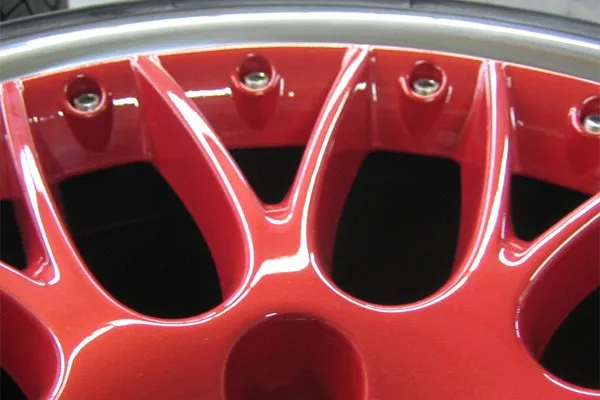
    Heavily oxidised Chrysler wheel: CNC diamond-cut, tempered and clear coated with acrylic powder.

  • Recoating

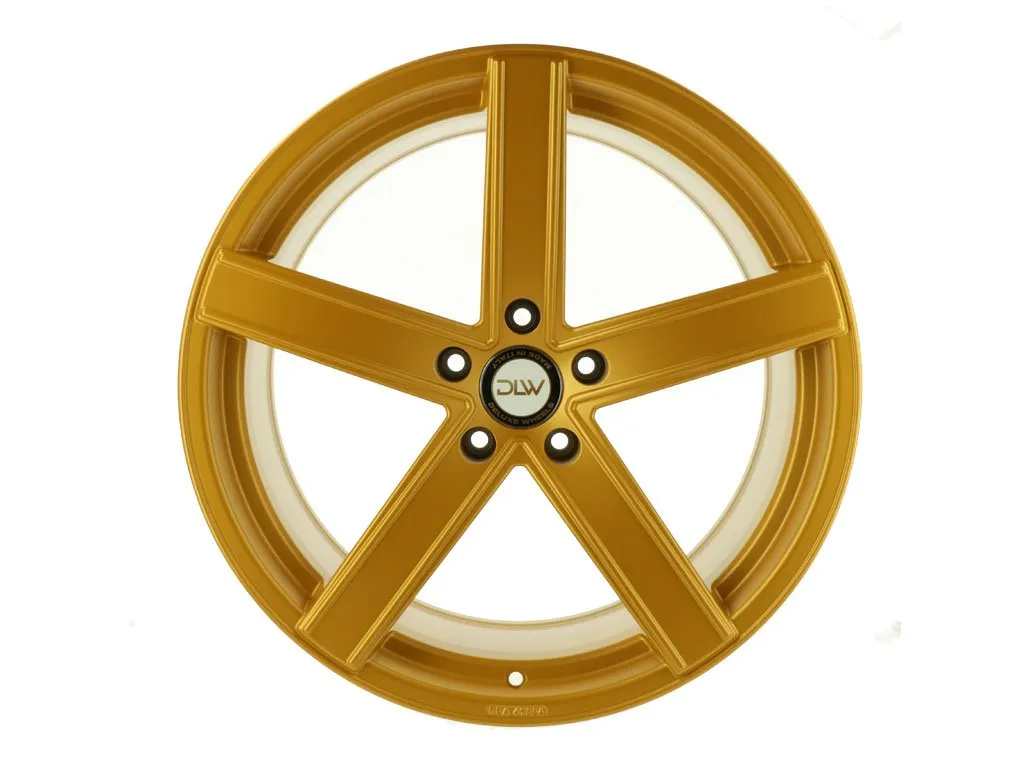
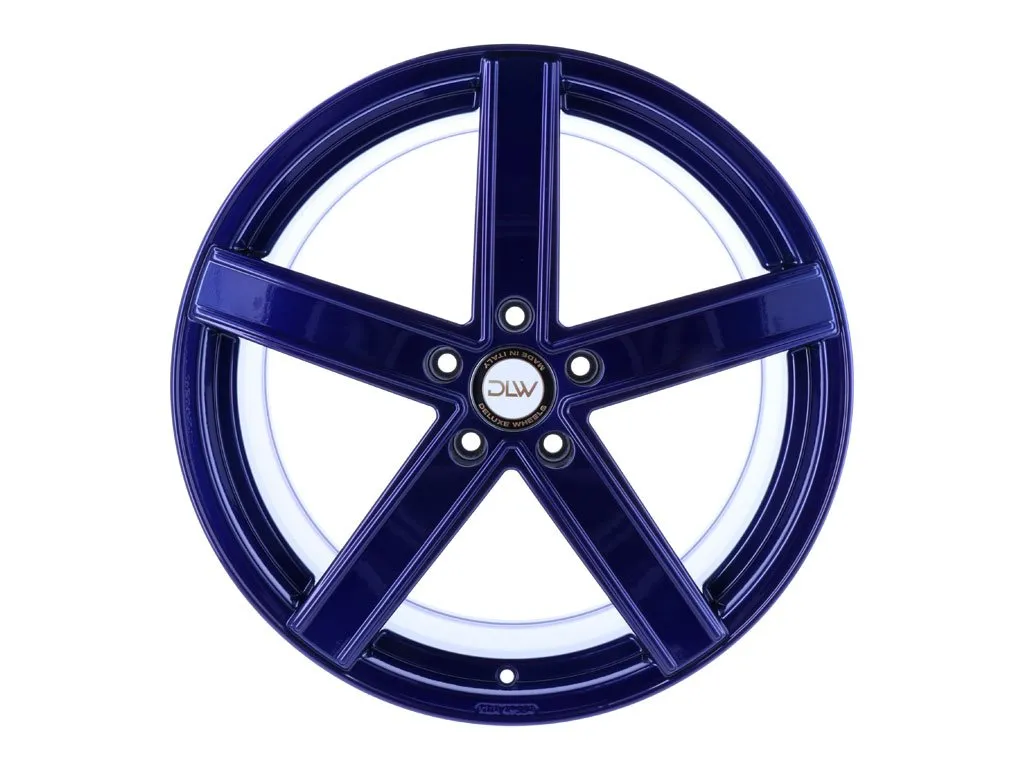
    Gold-painted DLW wheel (C4 Anodized Gold Matt): stripped, blasted, masked, primed, powder coated in Lollypop Blue and sealed with high-gloss acrylic.

  • Series production

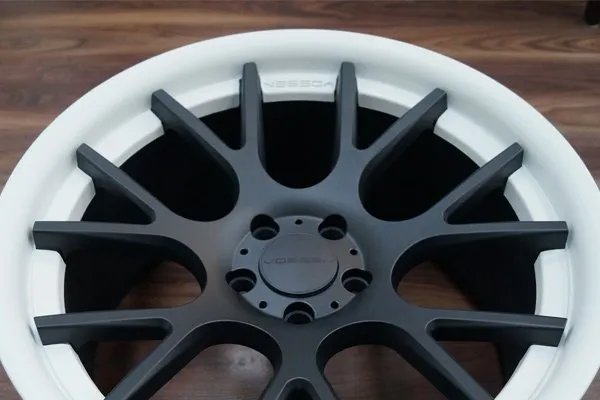
    New, uncoated DELTA wheel: phosphated, masked, powder primed and powder coated in matt black.

Solutions for powder coating wheels

The modular system that allows continuous expansion without changing systems.

Buying and running one

Who it is for

  • Garages, dealerships, tyre service

    From around 5 wheel sets per week, your own line pays off. Dealerships process lease returns in-house.

  • Paint shops, body shops, smart repair

    Coat wheels without trained painters. We train the staff, set up the line, supply consumables and provide support.

Questions before buying a powder coating line

How many wheels can the basic system handle per day?

Around 40 wheels in 8 hours with one coat, around 20 with two coats. Lines of any size are available on request.

Can all powder types be processed in parallel?

Yes. Care is needed with acrylic powder alongside other powder types; we recommend two manual units for this.

At what temperature and for how long is the powder cured?

160–200 °C; the wheels stay in the oven for 35–50 minutes. After cooling, the coating is fully cured and the tyre can be fitted.

Do the wheels have to be stripped first?

Yes, as a rule the whole wheel is stripped and blasted; partial coating techniques also exist. No sanding is needed before an acrylic clear coat over existing paint.

What are the connection ratings of the basic line?

Curing oven 39 kW / 60 A, powder coating station 6.5 kW / 20 A. Ovens are electric as standard, oil or gas on request. The oven exhaust air must be ducted outdoors and is installed by the customer; we assist with planning.

Do I need a permit?

Only from 10 kg of powder per hour. At 0.5–1 kg consumption per wheel set and coat, that corresponds to 40–80 wheels per hour.

What does a filter change cost?

Frequency-controlled booths need new filters less often; a complete change of all 8 filters costs under €500.

Can other parts be coated too?

Yes, any metal part that fits in the oven.

Where do I get powders and paints?

We supply powders, wet paints and all consumables through the online shop.

How quickly are staff ready to work?

After 1 to 2 days of training. We train the staff, set up the line and provide support.

Dipl.-Kfm. Thomas Beez

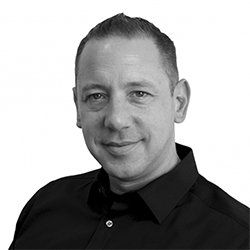
Our aim is to spare our customers years of work and setbacks. We do this by transferring our know-how from 20 years of wheel refurbishment during the training and the support that follows.

Dipl.-Kfm. Thomas Beez · Managing director, Mainhattan-Wheels GmbH

See powder coating in ongoing operation

In the demonstration centre in Dietzenbach we show you oven, booth and manual unit in use. Request a no-obligation quote: +49 (0) 6074 21 50 70.