

Powder coating wheels: costs, process and when it pays off
Prices for powder coating wheels by size and process, the seven steps of a professional coating, the colours available, the comparison with wet paint and when the investment adds up.
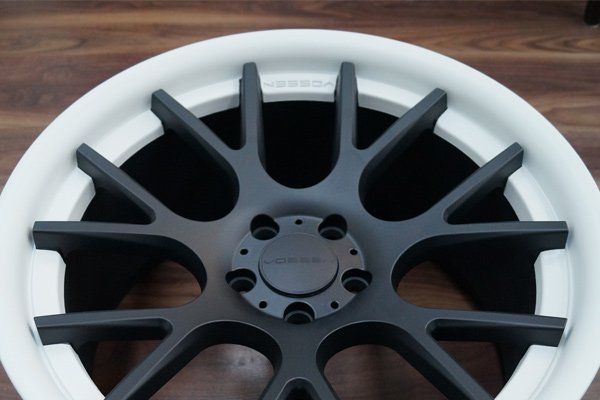
Looking at a price list for the first time, many drivers ask themselves: why does powder coating wheels cost more than a simple paint job, and is the difference worth it at all? The honest answer: in many cases yes, but not always. This article shows what a powder coating costs, which factors influence the price, what the process looks like in a specialist workshop and when the investment pays off economically.
What does powder coating wheels cost?
The cost varies with wheel size, condition, process and provider. Blanket prices rarely help here, but realistic price ranges from practice do.
Typical market prices by wheel size (per wheel)
| Wheel size | Single colour | Bi-colour | With CNC diamond cutting |
|---|---|---|---|
| up to 18 inch | €120 to €180 | €180 to €250 | €200 to €300 |
| 19 to 21 inch | €150 to €220 | €220 to €300 | €230 to €350 |
| 22 to 24 inch | €180 to €280 | €260 to €380 | €300 to €420 |
A complete set (4 wheels) in a single colour therefore falls in the range of €480 to €1,100, depending on size and process. For comparison: a new set of original alloy wheels for a premium-class vehicle quickly costs €1,500 to over €4,000. At that ratio, powder coating is almost always the better economic decision.
For work at Mainhattan-Wheels the current price list applies: powder coating €175, complete repaint €250, CNC diamond cutting €250 per wheel incl. VAT.
What drives the price up
Not every wheel is charged the same. These factors increase the work involved and therefore the price:
- Existing kerb damage: it has to be repaired before coating, roughly €25 to €80 extra per wheel.
- Heavy oxidation or corrosion: more involved stripping and pre-treatment required.
- Special colours (candy, metallic, effect paints): 20 to 30% surcharge compared with standard RAL colours.
- Bi-colour process: double the coating work with masking.
- Wheels over 20 inch: more material and oven capacity, a direct surcharge.
How does a professional powder coating work?
The result of a powder coating stands or falls not with the colour but with what happens before it. This is exactly where specialist businesses part company with cheap, quick providers.
Step 1: damage analysis and run-out check
Before anything is coated, a specialist business checks the actual condition of the wheel. That includes checking for radial and lateral run-out, cracks and changes in the material. Under the guidelines, a wheel with structural damage must not simply be coated over. More on this under Wheel inspection.
Step 2: chemical stripping
The old coating is removed completely, chemically in a warm immersion bath at 65 to 90 °C. The aluminium is left untouched. Anyone who instead blasts aggressively risks removing material and creating a poorer base for the new layer to key into.
Step 3: glass bead blasting and pre-treatment
After stripping, any remaining corrosion is removed by gentle glass bead blasting. Then comes the chemical pre-treatment (phosphating or chromating), which serves as the key for the powder coating. Without this step no coating will adhere permanently.
Step 4: damage repair
Light kerb damage and surface defects are now worked on and sealed to standard. Only once the wheel is technically sound does the process continue.
Step 5: electrostatic powder application
The powder coating is applied electrostatically with a spray gun. Thanks to the opposing charge, the particles adhere evenly across the entire surface, with no drips, runs or streaks.
Step 6: curing in the chamber oven
The coated wheel goes into the chamber oven at 160 to 200 °C. The duration and the exact temperature are decisive: too short or too low, and the powder coating does not cross-link fully. The result looks good but is mechanically unstable. Professional businesses monitor this process precisely.
Step 7: clear coat seal
A final clear layer of acrylic powder seals the surface additionally and protects against UV radiation, brake dust and road salt. This step is particularly worthwhile on wheels that are driven all year round.
Which colours are possible?
With powder coating the options are considerably wider than with classic wet paint. Available are:
- RAL colours: the complete RAL palette, matt or gloss, several hundred standard colours
- Metallic paints: anthracite, titanium, silver with a metallic effect
- Special colours: candy paints, effect powders, NCS colours
- Bi-colour: two colours on one wheel, typically with a contrasting rim bed
Currently particularly in demand are matt black (RAL 9005), satin anthracite and silver with a gloss level, timeless options that suit almost any type of vehicle. Anyone wanting to restore an original manufacturer colour (for example Audi Tactical Green or BMW Frozen Black) needs a custom mix; that is possible, but at a surcharge. You will find an overview of our surfaces under Wheel colours.
Powder coating or painting: the real difference
This question comes up in every second consultation. The answer is clearer than many think.
| Criterion | Powder coating | Wet paint |
|---|---|---|
| Durability | 5 to 10 years | 2 to 4 years |
| Corrosion protection | very high | medium |
| Stone chip protection | high | medium |
| Range of colours | very wide | very wide |
| Repairability | complete recoat necessary | possible locally |
| Cost | higher | cheaper |
| UV resistance | very high | medium |
The decisive point: paint is cheaper, but only at first glance. Anyone who has to go back to the workshop two years later has paid more in the end. Powder coating is a one-off investment that adds up. Details on both processes under Powder coating and painting.
When is powder coating worthwhile?
Powder coating is worthwhile when
- the wheels are high-quality or original (Audi, BMW, Mercedes, Porsche),
- there is heavy use: high mileage, winter driving, a heavy vehicle,
- the wheel is to be completely renewed visually (colour change, tuning),
- long-term durability without rework is required,
- a lease return is coming up and the original look is needed.
It makes less sense when
- the wheel has structural damage; then repair or replace it first,
- there is only a small, local scratch; then a targeted wheel repair is often enough,
- the vehicle is about to be sold and only needs a cosmetic freshen-up.
One point many people do not consider: powder-coated wheels cannot be touched up locally. Anyone who wants to repair just one spot after fresh kerb damage has to recoat the whole wheel. That belongs in the decision.
What many people only find out after coating
Three mistakes come up again and again when choosing a provider:
- The preparation is cut short. Anyone who saves on stripping or blasting delivers a coating with an expiry date. The oxide layer on aluminium forms within minutes; if it is not removed completely, the powder coating does not adhere to the base metal.
- The curing temperature is not monitored. Too low an oven temperature means: visually good, mechanically unstable. Often only noticeable after the first winter.
- No check of the base metal before coating. Micro-cracks or porosity in the aluminium push the coating off from within. A reputable business checks the condition of the wheel before any powder is applied at all.
Mainhattan-Wheels carries out every one of these steps under control, from damage analysis through chemical stripping to the finished coating. The focus is not on speed but on a result that lasts.
Conclusion
Powder coating wheels costs between €120 and €280 per wheel on the market, depending on size, process and condition. That is more than painting. But the difference shows not at first glance, rather after two winters, 50,000 kilometres and a wheel cleaner that does not attack the surface. Invest properly once and you do not pay twice. The decision in favour of powder coating is therefore not only a question of looks but a question of economics. For a concrete quote, send us pictures of your wheels via the request form.
Frequently asked questions
What does powder coating wheels cost on average?
On the market €120 to €280 per wheel, a complete set between €480 and €1,100, depending on size and process. At Mainhattan-Wheels the fixed price of €175 per wheel from the price list applies.
How long does a professional powder coating on wheels last?
With correct preparation and regular care, 5 to 10 years. The pre-treatment decides this, not the paint.
Which colours are possible?
All RAL colours, metallic, candy, NCS and bi-colour, matt or gloss. Manufacturer colours on request.
When is powder coating more worthwhile than painting?
With high-quality wheels, heavy use, winter driving or a lease return, whenever durability counts.