

Buying a CNC lathe for wheels: which model suits your workshop and when does it pay off?
Which CNC lathe fits which business, what is included in delivery and from how many wheels per day the purchase pays for itself in around six months.
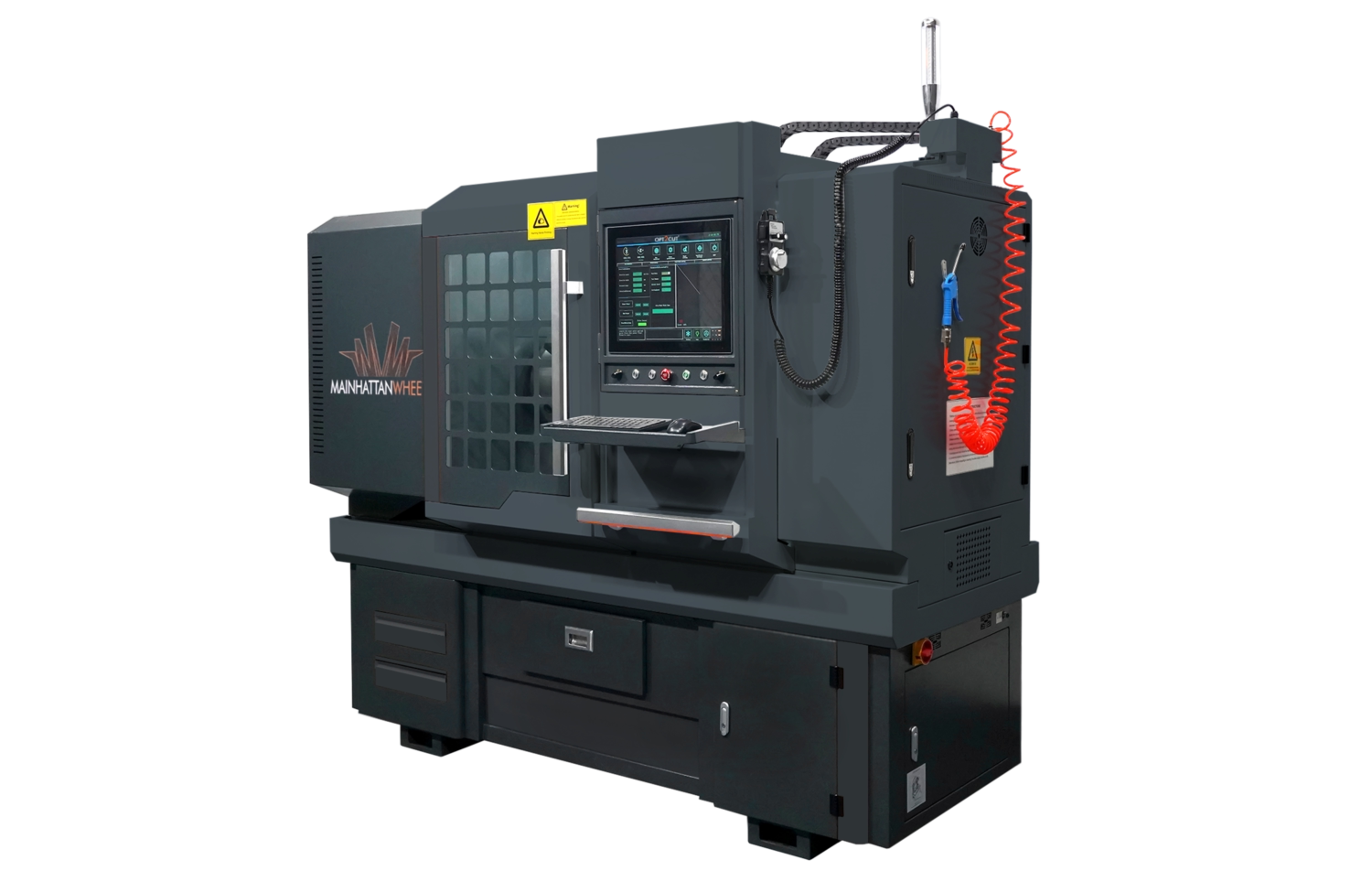
The share of diamond-cut wheels in the vehicle market keeps growing. For dealerships, garages, body shops and smart-repair businesses this raises a question that can no longer be postponed: is buying your own CNC lathe for wheels worthwhile, or does outsourcing remain the better option?
The answer depends on the right model. And on whether the investment can be calculated. This article shows which machine suits which business, when the purchase actually pays for itself and which mistakes become expensive.
Why in-house CNC technology is no longer a luxury
Diamond-cut wheels cannot be repaired with polish or paint. The only correct method is renewed CNC diamond cutting, exactly following the manufacturer’s process.
Workshops without their own machine are forced to give these jobs away. That means:
- less revenue per vehicle
- longer turnaround times for the customer
- dependence on external service providers
- no control over quality and result
Which model suits your workshop?
Three factors decide: volume, floor space and infrastructure.
| Model | Design | Footprint | Power supply | Ideal for |
|---|---|---|---|---|
| CNC-MW28X | vertical | 1.35 m² | 400 V | small to medium workshops |
| CNC-MW30V-Mobil | vertical | 0.95 m² | 230 V | flexible businesses without three-phase power |
| CNC-MW28TX | horizontal | standard | 400 V | high throughput, continuous use |
| CNC-MW28H | horizontal | standard | 400 V | industry, high-volume businesses |
All models are delivered complete, including turning tools, contour-capture system and OPT2CUT software (annual licence).
When does the investment pay off?
This is the decisive question, and the answer is more concrete than many expect.
- CNC-MW28X: from about 2 wheels per day, payback in around 6 months
- CNC-MW28TX: from about 4 wheels per day, payback in around 6 months
- CNC-MW30V-Mobil: from about 2 wheels per day, comparable timeframe
The return does not come only from the revenue per repair. Add the saved outsourcing costs, faster turnaround and considerably stronger customer loyalty because the repair stays in-house.
What is often underestimated when buying
Many businesses focus exclusively on the purchase price of a CNC machine. Yet other factors shape daily operation:
- How quickly are staff ready to work? After 1 to 2 days of training.
- Are spare parts available in case of failure? Yes, including complete replacement machines if needed.
- Is support reachable when it counts? Service technicians operate throughout Europe.
Mainhattan-Wheels does not deliver a device but a complete operator package, from commissioning through training to ongoing maintenance.
Conclusion
Buying a CNC lathe is not an expense but a calculable investment with a measurable return. Anyone who chooses the right model for their business is usually in the black within six months. Anyone who waits keeps financing the competition.
All models, technical details and current prices are on the page CNC lathes for diamond cutting wheels.
Frequently asked questions
Which CNC lathe suits small workshops?
The CNC-MW28X needs only 1.35 m² of floor space and pays for itself from two wheels per day in around six months.
How long does the training take?
Depending on the model, staff can work independently after one to two days of training.
When does a CNC lathe for wheels pay off?
With two to four wheels a day, usually within six months.
What is included in delivery?
All models are delivered complete, including turning tools, contour-capture system and OPT2CUT software.