

Buying a powder coating line for wheels: what workshops need to know before investing
Why a wheel-specific line makes the difference, which components belong to it (chamber oven, powder booth, manual powder system), which businesses the investment pays off for and what to check before buying.
Anyone who currently sends wheels out for coating knows the problem: waiting times, variable quality and margins that stay with the service provider. Your own powder coating line solves exactly that. But not every line is suitable for wheels. This article shows what garages, dealerships and smart-repair businesses need to know before buying.
Why a wheel-specific line is the difference
General powder coating lines are designed for many applications. Wheels make particular demands: complex geometries, differing material thicknesses and tight tolerances in the curing process. A line optimised for wheels differs in three decisive points:
- Oven temperature: Siemens controls with a deviation of only around 0.1 °C guarantee exact curing parameters, decisive for the powder paint to cross-link fully.
- Powder booth: an extraction capacity of at least 8,000 m³ per hour prevents contamination between different types of powder paint.
- Software-based curing analysis: curing time and temperature are calculated exactly for each type of powder paint, not estimated.
Anyone who instead opts for a cheap universal line is investing in a result that will not meet the demands of professional wheel coating for long.
What a complete powder coating line includes
A working line for wheel coating consists of several components that have to be matched to each other.
Curing oven (chamber oven)
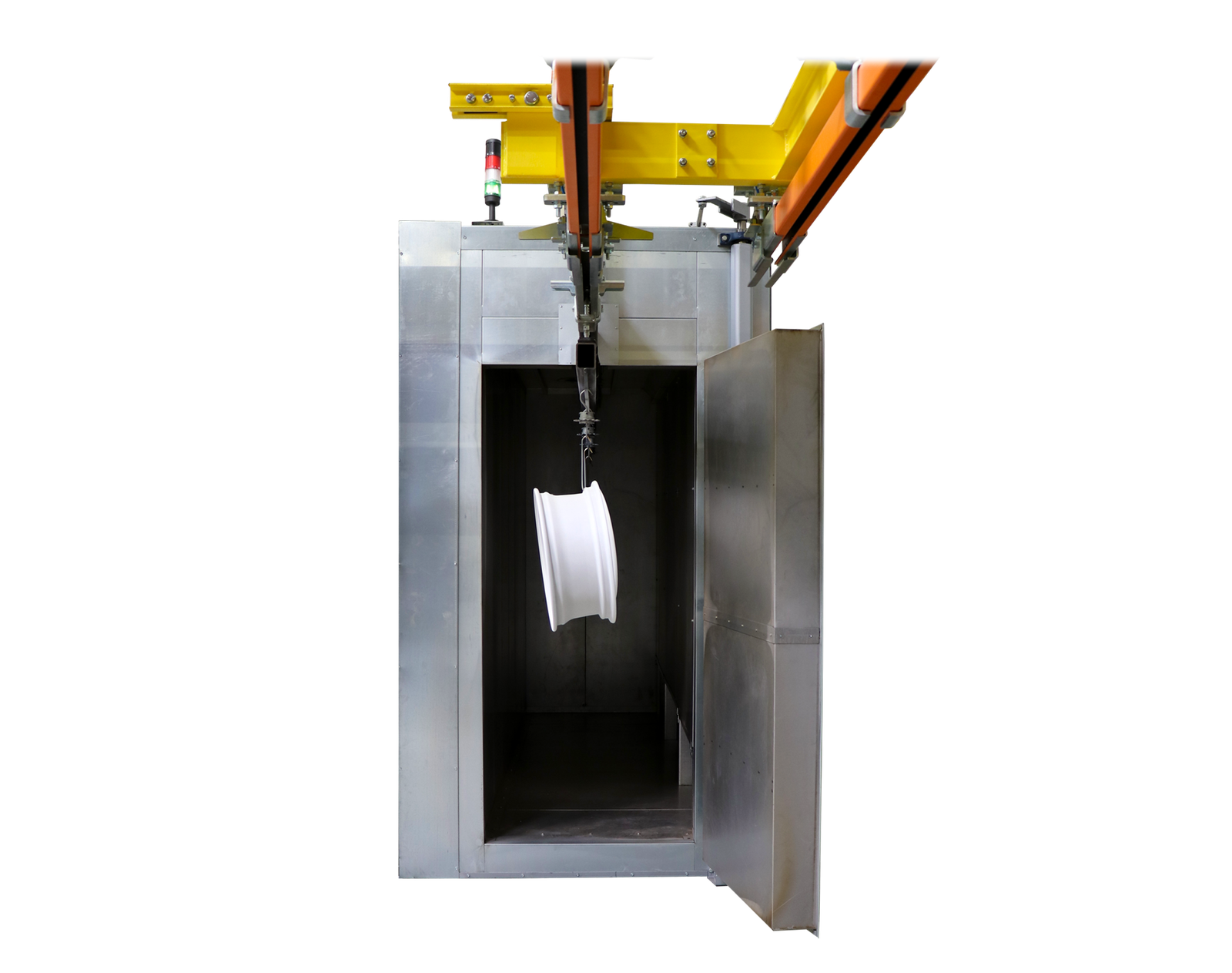
The heart of every line. Depending on the type of powder paint, wheels are cured at 160 to 200 °C. The average dwell time is 35 to 50 minutes. A high-quality curing oven is hot-dip galvanised, reinforced with structural steel and insulated with 150 mm of rock wool, for stable temperatures and low energy costs.
Powder booth
The powder booth houses the electrostatic application of the powder paint. What matters is a frequency-controlled control unit and a powerful filter system, on professional lines with an 8-filter system and polyester filter cartridges.
Powder gun (manual powder system)
For wheel work, systems such as the Gema OptiFlex Pro Q or Pro B Spray have proved themselves, from polyester primers to acrylic powder paints for the clear coat. Compared with a standard powder coating line, wheel-specific handheld units offer considerably more control on complex spoke geometries.
Expandability
A future-proof line can be extended without changing systems, for example with a monorail system instead of oven trolleys, an integrated wet paint booth or additional curing ovens for higher volumes.
Which businesses benefit most
A powder coating line for wheels pays off for:
- Garages from around 5 sets of wheels per week: payback realistic
- Dealerships with a reconditioning department: handling lease returns in-house
- Body shops and paint shops: a new source of income without trained sprayers
- Smart-repair businesses: an entry into wheel coating with predictable processes
The advantage over wet paint: with one to two days of training, staff can coat to a high standard straight away.
What should be checked before buying
Not every line pays off in the long run. Before investing, workshops should check:
- CE-compliant and exempt from permits up to 10 kg of powder paint per hour?
- Software-based set-up and a loaded oven measurement included?
- Training, commissioning and 24-hour spare parts service in the package?
Mainhattan-Wheels in Dietzenbach has been developing powder coating lines for over 20 years, directly out of its own repair business. That practical experience goes into every line. For complete preparation, a paint stripping line and a blast cabinet also belong in the process chain.
Conclusion
A powder coating line for wheels is not an impulse purchase but a strategic decision in favour of quality, independence and new margins. Anyone who opts for a wheel-specific line with Siemens controls, a precise curing oven and a professional manual powder system coats to manufacturer standard from day one. Anyone who saves pays later through poorer results, follow-up complaints and missing support. You will find all technical specifications, configuration options and training packages under Powder coating lines and Training and support.
Frequently asked questions
How many wheels can be coated per day?
With the basic system around 40 wheels per day with a single-layer application, and around 20 wheels per day with a two-layer coating.
How long does the training take before you can coat yourself?
After one to two days of hands-on training, staff can coat to a professional standard.
Can I extend the line later?
Yes. The modular system allows extensions such as a monorail, a wet paint booth or additional ovens without changing systems.
Is the line also suitable for other parts?
In principle yes: all metal parts that fit in the oven can be coated. The line is, however, optimised specifically for wheels.