

Stripping wheels: chemically or by blasting?
Chemical stripping in a dip tank or blasting: which process is kinder to the aluminium, when glass bead blasting makes sense and why the order of the steps decides how long the finish lasts.
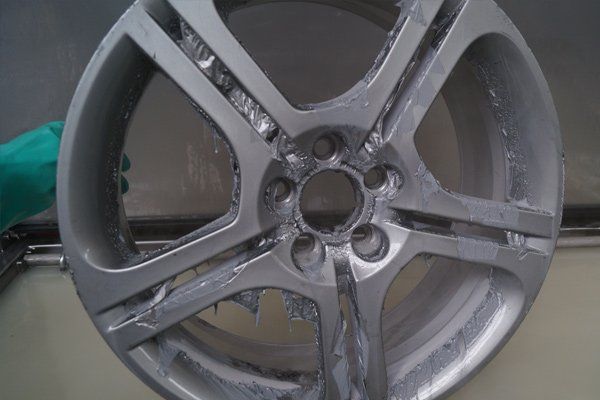
Before a wheel can be recoated, the old layer has to be removed completely. That sounds simple, but it is not. The choice of stripping process does not only decide how clean the surface becomes. It also decides whether the base material is still in faultless condition afterwards or has been permanently weakened. Two methods dominate in practice: blasting and chemical stripping. Both have their place, but not for every wheel and not under the same conditions.
What really happens during stripping
Stripping is not only about removing old paint. It is about preparing the aluminium surface so that a new coating adheres optimally without the material being attacked. That is the point at which the two processes differ fundamentally.
Blasting: when it works and when it does damage
In blasting, the wheel is worked with abrasive media under high pressure. The old coating is removed mechanically. That is effective, but only under certain conditions. Conventional blasting with aggressive media is not recommended for aluminium wheels. The reasons:
- Sharp-edged media roughen the sensitive aluminium surface.
- Material is removed from the base metal.
- Foreign particles can remain in the surface and trigger corrosion later.
- With powder-coated wheels the media has to be particularly aggressive, which puts the surface under additional stress.
When blasting makes sense
After chemical stripping, targeted glass bead blasting can be worthwhile. Not for the stripping itself, but to remove residual corrosion and improve the adhesion of the new coating. That is a controlled use with the right media, not a replacement for stripping.
Chemical stripping: the material-friendly standard
In chemical stripping the wheel is immersed in a warm dip tank with an alkaline or acidic stripping solution, at 65 to 90 °C depending on the type of coating. The chemical reaction dissolves the paint structure without attacking the aluminium. The advantages at a glance:
- no material removal from the base metal
- the surface stays smooth and structurally unchanged
- residue-free removal even of stubborn powder coat layers
- no foreign particles in the surface
- a prerequisite for precise subsequent work such as high-gloss compaction or CNC diamond cutting
With high-quality alloy wheels in particular this is the only method worth recommending, because any material removal directly affects the later result of the coating.
Direct comparison: blasting and chemical stripping
| Criterion | Blasting | Chemical stripping |
|---|---|---|
| Material removal | yes, depending on the media | no |
| Surface structure | roughened | smooth and unchanged |
| Suitable for alloy wheels | within limits | yes, recommended |
| Residues | possible | residue-free |
| Before powder coating | conditionally | optimal |
| Before high-gloss compaction | not suitable | absolutely essential |
| Cost | cheaper | somewhat higher |
The table shows it clearly: for most reconditioning processes, especially before powder coating, CNC diamond cutting or high-gloss compaction, the chemical process is the technically superior choice.
Which process for which case?
Chemical stripping is the right choice when
- aluminium wheels are to be recoated,
- a diamond-cut or high-gloss surface follows,
- maximum adhesion of the new coating is required,
- the wheel is high-quality or rare.
Blasting can make sense when
- residual corrosion has to be removed after chemical stripping,
- steel wheels are being worked on,
- glass bead blasting with the right media is used in a controlled way.
What the wrong route costs in the long run
Roughened base metal offers poorer adhesion. A new powder coating on a damaged surface lasts less long. And corrosion caused by embedded foreign particles often only shows up months later, working from the inside out. Anyone who economises on the stripping or chooses the wrong process pays for it at the next reconditioning at the latest.
That is why Mainhattan-Wheels relies exclusively on soft chemical stripping as the controlled first step before any further work. The fine blasting that follows only serves to prepare the already stripped surface. Details of the process can be found on the Stripping and blasting page.
Conclusion
Blasting and chemical stripping are not equivalent alternatives, at least not for alloy wheels. The chemical process is kind to the base metal, leaves no residues and creates the best starting point for any subsequent coating. Blasting can make sense as a supplementary step, but never as the sole method for stripping alloy wheels. Anyone who wants long-term durability starts with the right stripping, not with the coating.
Frequently asked questions
Why should alloy wheels not be blasted?
Aggressive blasting removes aluminium, roughens the surface and can leave behind foreign particles that cause corrosion later.
What is chemical stripping?
The wheel is immersed in a warm dip tank with stripping solution. The coating dissolves without residue and without the base metal being attacked.
Which process is better before powder coating?
Chemical stripping. It leaves a clean, unchanged surface with an optimal basis for the adhesion of the new coating.
Can you strip chemically first and then blast?
Yes, in that order it makes sense: chemical stripping as the main step, followed by targeted glass bead blasting to remove residual corrosion.