

Repairing kerb damage on a wheel: costs, methods and limits
When kerb damage on an alloy wheel can be repaired, which methods are used depending on the damage, what the repair costs and when only a replacement remains.
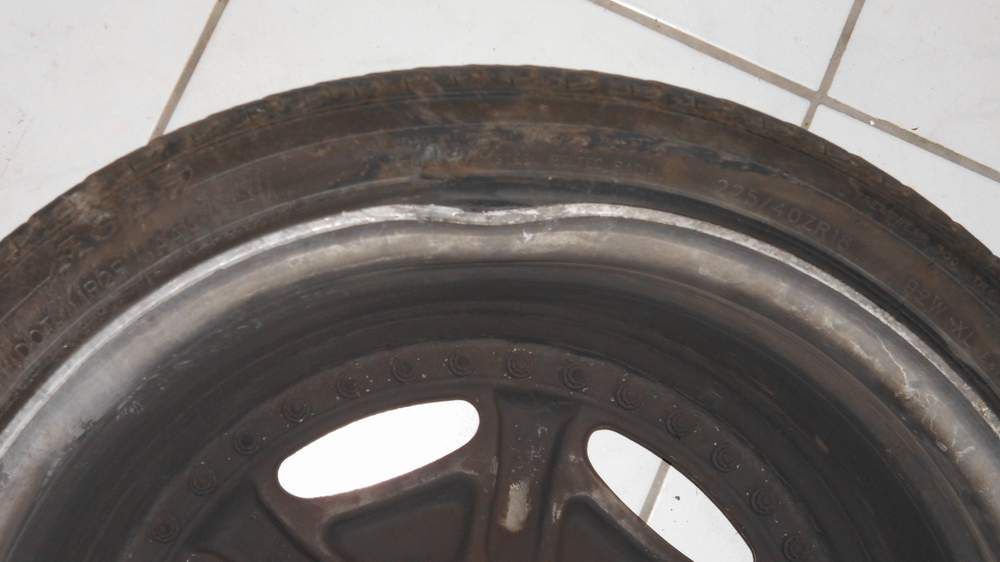
It happens in seconds: one misjudged turn, an unexpected kerb, and the wheel takes the hit. The reaction is usually the same: a quick look, the hope that it is not too bad, and the decision is postponed. That is exactly where the problem starts. Kerb damage on a wheel is not always what it seems at first glance. Some scratches look harmless and are. Others look trivial and are not. This article explains which methods help with kerb damage, what the repair costs and when it no longer makes sense.
What happens with kerb damage
A kerb strike always hits the most sensitive part of the wheel: the outer lip. Depending on the angle and speed of impact the result is
- a superficial scratch in the paint,
- deeper material loss in the aluminium,
- a deformation of the rim edge
- or, in the worst case, structural damage with displaced material.
What matters is not how big the damage looks but how deep it is and whether the base material is affected.
When can kerb damage still be repaired?
There is a clear limit here that is relevant both technically and legally.
Repairable:
- damage up to a maximum of 1 mm deep in the base metal
- scratches no further than 50 mm from the rim edge
- pure paint damage without material loss
- superficial scratches without deformation
No longer repairable:
- cracks in the material
- severe deformation or displaced material
- radial or lateral run-out with structural damage
- damage affecting the wheel bed
Damage beyond these limits must not be repaired for road use. A replacement is then the only safe decision.
Which methods are used?
Not every wheel damage is treated the same way. The method depends directly on the type of damage.
| Damage | Method | Result |
|---|---|---|
| Superficial scratch | sanding and painting | visually as new |
| Deep material loss | sanding, filling and three-layer paint | very good result |
| Diamond-cut wheel | CNC diamond cutting and recoating | manufacturer quality |
| Paint damage without scratches | stripping and repainting | clean and durable |
With diamond-cut wheels in particular, simple sanding is not enough. Here a new CNC machining is essential to restore the characteristic surface correctly. Anyone who ignores this will see the difference immediately.
What does repairing kerb damage cost?
The cost depends on the extent of the damage and the type of wheel. Typical price ranges on the market:
- Light scratch, paint damage: €80 to €150 per wheel
- Deep kerb damage with material loss: €150 to €250
- Diamond-cut wheel (CNC repair): €250 to €400
- Large wheels from 20 inch: surcharge of €30 to €80 depending on the work
For work at Mainhattan-Wheels the prices in our current price list apply: powder coating €175, complete repaint €250, CNC diamond cutting €250, run-out repair €150 per wheel incl. VAT.
For comparison: a new alloy wheel costs €300 to €1,200 each depending on model and manufacturer. In most cases the repair is by far the more economical decision.
What many people underestimate with kerb damage
Three mistakes happen again and again.
Waiting too long. An untreated scratch in the aluminium oxidises. What can be repaired today can become far more involved within a few weeks through corrosion.
Choosing the wrong workshop. Not every business has the right equipment. Especially with diamond-cut surfaces or large wheel diameters, the equipment decides the result.
Looking only at the price. A cheap quick repair can hide the damage but not fix it permanently. Anyone back in the workshop six months later has paid more in the end.
At Mainhattan-Wheels every kerb damage is analysed individually before any grinder is used. Material condition, wheel type and the chosen method are matched to one another.
Conclusion
Repairing kerb damage on a wheel is possible in most cases and considerably cheaper than a replacement. What matters is how deep the damage really is, which method fits and when the limit of repairability is reached. Anyone who waits too long or chooses the wrong workshop pays more in the end for a worse result. A professional damage assessment is therefore not an optional step but the most important one. Send us photos of your wheels via the request form and we will assess the damage in advance.
Frequently asked questions
Can every kerb damage on a wheel be repaired?
No. Damage up to 1 mm deep and within 50 mm of the rim edge can be repaired. Cracks, deformation or structural damage cannot.
What does it cost to repair kerb damage?
Depending on depth and wheel type, between €80 and €400 per wheel on the market. Diamond-cut wheels are more involved and correspondingly more expensive. The fixed prices of Mainhattan-Wheels are in the price list.
How do I know whether my kerb damage is still repairable?
Only through a professional diagnosis in a specialised workshop, not by looking alone.
Does insurance pay for kerb damage?
Usually not. Self-inflicted kerb damage is covered neither by partial cover nor by third-party insurance.