

Candy, bicolour or high-gloss compaction: which wheel finish really lasts
Three finishing processes compared: build-up, durability, cost and care requirements of candy paint, bicolour with CNC diamond cutting and high-gloss compaction, and which process suits which vehicle.
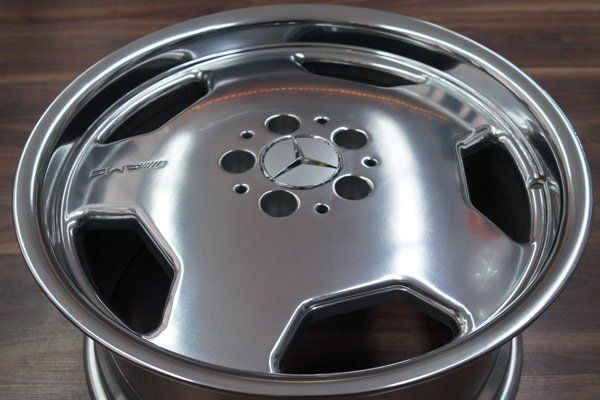
Anyone who wants to give their wheels more than just colour faces a decision that is about more than taste. Candy paint, a bicolour surface or high-gloss compaction: all three processes look impressive at first glance. Yet they differ fundamentally in effort, care requirements, durability and cost. Anyone who does not know that chooses by appearance and wonders a year later why the result no longer delivers what it promised.
What lies behind the three processes?
Candy paint
With candy paint a semi-transparent powder coat, the so-called candy glaze, is applied over a prepared base surface. The result is a deep, metallic-shimmering colour with pronounced depth of gloss.
- individual colour effect, from copper through ice blue to candy red
- multi-layer build-up: primer, candy glaze, clear coat
- visually striking, especially in direct light
Bicolour surface
Bicolour is created by the contrast between a diamond-cut aluminium area and a colour coating on the rest of the wheel. Timeless, close to factory specification and currently one of the most sought-after styles in wheel finishing.
- factory-style look as delivered by many manufacturers
- the basis is always CNC diamond cutting after the coating
- long-lasting with little care needed
High-gloss compaction
The most involved process. The wheel is clamped in vibratory baths with ceramic polishing media in several stages, for up to 20 to 35 hours per wheel. The metal is not only polished but physically compacted and hardened.
- chrome-like mirror gloss without any colour application
- no paint layer, therefore no flaking
- only possible at specialised businesses
Direct comparison: durability, cost, care
| Process | Durability | Market price per wheel | Care requirement |
|---|---|---|---|
| Candy paint | 3 to 5 years | €150 to €350 | medium |
| Bicolour (CNC) | 4 to 6 years | €250 to €400 | low |
| High-gloss compaction | 5 to 8 years | €150 to €300 | regular |
The binding fixed prices for the work at Mainhattan-Wheels (powder coating €175, CNC diamond cutting €250 per wheel incl. VAT) are listed in the price list.
One point many people only learn later: high-gloss compacted wheels cannot be painted over. Anyone who wants to change the colour later has to remove the entire compaction. That costs €300 to €600 per wheel and then requires a complete reconditioning.
Which process suits which vehicle?
Not every wheel finish suits every usage profile.
- Candy: for vehicles with an individual tuning ambition, seasonal use or show cars.
- Bicolour: for everyday and premium vehicles that are meant to combine factory-level quality with an individual look.
- High-gloss compaction: for classics, sports cars and drivers who prefer chrome-like gloss without a paint layer and who keep to a regular care routine.
What many people only learn after the finishing work
Every wheel finish is only as good as the preparation before it. Without complete stripping, clean blasting and correct priming, no surface lasts as long as it should, regardless of the process chosen. That is why Mainhattan-Wheels does not decide by a standard recipe, but according to the type of wheel, its initial condition and the goal, which process makes technical sense and how it will last.
Conclusion
Candy, bicolour and high-gloss compaction are three fundamentally different approaches with different results, costs and requirements. Anyone who decides on appearance alone often makes the wrong choice. Anyone who assesses the process, the care requirement and the usage profile together gets a surface that still convinces years later. For all three processes the same applies: durability is not decided at the finish, but in the preparation and in the experience of the business carrying out the work. If you are unsure which surface suits your own vehicle, have the type of wheel and its condition assessed first. Send us pictures via the request form.
Frequently asked questions
What is the difference between candy and bicolour?
Candy is a coloured powder glaze with depth of gloss. Bicolour is created by CNC diamond cutting after the coating; the contrast between bare aluminium and colour makes the look.
How long does high-gloss compaction last?
With regular care, 5 to 8 years. Without care the surface loses its gloss considerably sooner.
What does a wheel finish cost on average?
Depending on the process, between €150 and €400 per wheel, depending on size, condition and method. The fixed prices of Mainhattan-Wheels are listed in the price list.
Can bicolour wheels be repaired?
Yes, but only by CNC diamond cutting again. Simple polishing does not restore the characteristic surface.