

High-gloss compaction or painting your wheels? Which solution fits better
What really happens to a wheel in the vibratory bath, why it is not polishing, when painting or powder coating is the better choice and what both processes cost per wheel.
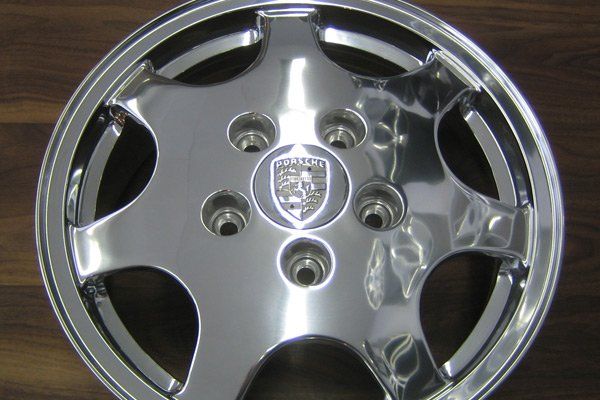
High-gloss compaction suits you if you want a continuous mirrored aluminium look and use the car mainly in summer. Painting suits you if a particular colour is required, the wheel comes in with damage, or the car runs all year round.
Two identical sets of wheels, same car, same budget. One comes back high-gloss compacted, the other painted. After two winters only one of them still looks the way it did on collection day. The difference rarely lies in the process. It lies in whether the decision suited the wheel and the way the car is actually used.
High-gloss compaction: what actually happens
Many people imagine it as a particularly thorough polish. That is not quite it.
Hours of work in the vibratory bath
The alloy wheel is first chemically stripped. It then passes through several vibratory baths with ceramic abrasive media, stage by stage getting finer. The constant vibration acts like countless tiny hammer blows on the metal. Two things happen at once: the surface reaches a chrome-like mirror shine, and the structure compacts and becomes harder. That is exactly where the name comes from. The shine is one half, the denser lattice structure the other, and it is that which makes the surface more resistant to oxidation than a pure polish.
Why compaction is not polishing
With classic high-gloss polishing using a cloth wheel, the wheel only reaches the open faces. Edges and narrow gaps between spokes stay dull and the result looks patchy. With compaction every angle is reached. Anyone who wants their wheels mirror polished today almost always means this result.
No everyday use without a sealant
No material is applied, unlike with chrome plating. What remains is bare, compacted aluminium. So that the surface can withstand moisture and road salt, we seal it on request with a high-strength acrylic coating. The gallery under High-gloss compaction and polishing shows the results.
What happens when painting
Here material is built up instead of removed, and that is exactly what determines colour, protection and later repairs.
Powder coating or wet paint
After stripping and blasting come primer, colour coat and a clear acrylic powder layer. The colour is usually applied as a powder coating: more stable, cheaper, kinder to the environment. We use wet paint where special effects or the exact original colour are required. Practically anything is possible: the original colour to the manufacturer’s code, matt anthracite, candy tints or two-tone with a contrasting spoke star.
The underrated advantage: reworking individual wheels
A colour can be reproduced exactly at any time. If one wheel picks up kerb damage in three years’ time, that one wheel is rebuilt. With a compacted wheel that is not possible, because the gloss pattern has to be uniform across all four wheels. You will find colour concepts and examples under Powder coating and painting.
The direct comparison
| Criterion | High-gloss compaction | Painting |
|---|---|---|
| Look | chrome-like, mirrored, single colour | any colour, matt to gloss, two-tone as well |
| Scratches and corrosion | ground out with the surface, deep damage stays visible | covered completely |
| Surface hardness | higher thanks to the compaction effect | depends on the coating build-up |
| Repairing a single wheel | hardly possible, usually the whole set | no problem |
| All-year use | only with an acrylic seal | very well suited |
| Price per wheel | higher | cheaper |
Which wheel can take which process?
Whether wheels can be high-gloss compacted is decided by the material, not by taste.
Cast, forged and multi-piece wheels
Porous castings show every flaw in a mirrored surface. With forged wheels this practically never happens. Multi-piece wheels are excellent candidates for compaction because the individual parts can be worked on separately.
When scratches and oxidation sit too deep
Deep scratches and advanced corrosion cannot be ground away without losing too much material. Here the route via blasting and a fresh build-up gives the cleaner result. Cracks and deformation rule out both processes.
Inspection before the work starts
Every wheel goes through a wheel inspection with 3D laser measurement with us before any work begins. With a purely cosmetic surface finish the colour is not the central issue. What remains relevant are the technical properties and the requirements that apply to the vehicle.
Why the way you drive usually decides for you
Summer wheels, classics, show cars
Anyone having their wheels high-gloss compacted gets the maximum out of it here. The shine reaches a depth no paint can imitate, and the harder surface forgives car washes and brake dust better than a pure polish.
All-year use and road salt
A commuter car in the Rhine-Main region sees salt, moisture and stone chips. Without a sealant, a compacted wheel visibly loses gloss there. For that kind of use we recommend paint or powder coating, without a long discussion.
What you should budget for
- Painting wheels: €80 to €200 per wheel on the market, depending on the work and the coating build-up
- High-gloss compaction: considerably more, usually €150 to €250 for one-piece wheels, multi-piece wheels are higher
The reason is the sheer machining time in the vibratory bath, which cannot be sped up. The fixed prices for powder coating (€175) and a complete repaint (€250 per wheel incl. VAT) are in our price list.
What actually drives the price per wheel
The deciding factors are the size in inches, the spoke geometry and the condition on arrival. A 21-inch wheel with a delicate spoke star takes more time than a plain five-spoke design. If corrosion or kerb damage is involved, it is repaired first, which is a separate operation. That is why we only quote binding prices for compaction once we have seen the wheels.
Conclusion
The two processes solve different problems. High-gloss compaction delivers a look no paint can match, but it costs more and is inflexible if damage occurs. Painting gives you freedom of colour, repairability and winter security. The wrong decision is rarely obvious straight away, usually only after the first season. Not sure what suits your wheels? Send us photos through the request form. We will also tell you if a process makes no sense for your wheel.
Frequently asked questions
Is high-gloss compaction the same as diamond cutting?
No. With diamond cutting the front face is skimmed on a CNC lathe, leaving fine grooves and a two-tone look. Compaction reaches the whole wheel and creates a closed mirror surface with no structure.
Can a high-gloss compacted wheel be painted later?
Yes. The wheel is blasted, primed and built up again. The other way round is more involved, because it first has to be stripped completely.
Does high-gloss compaction last through winter?
Only with an acrylic seal. Without a protective layer, road salt and moisture attack the bare aluminium.
How long does the work take?
Painting is usually finished within one to two working days. Compaction takes considerably longer, because the vibratory baths alone need several hours per stage.