

Wheel with radial run-out: recognising the causes and putting them right
What radial run-out is, how it develops, which driving symptoms point to it, how run-out is measured with a dial gauge and a 3D laser, and when the wheel can be straightened.
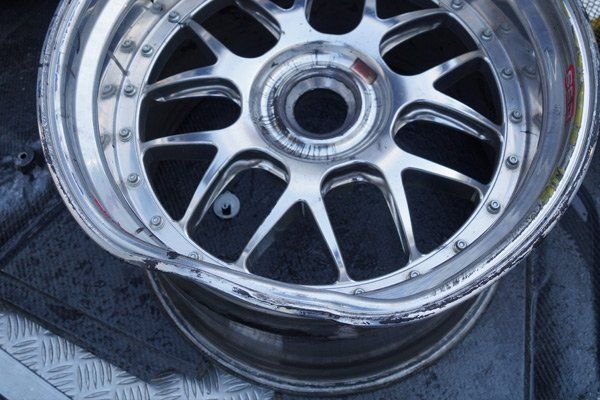
A restless feel through the steering wheel, a slight shudder from certain speeds upwards: often a wheel with radial run-out is the reason. What many people do not know is that the damage is usually invisible. The wheel looks unremarkable, but no longer runs exactly true. This article explains how radial run-out develops, how to recognise it and what options there are to put it right properly.
What does radial run-out mean on a wheel?
A wheel with radial run-out no longer runs exactly circular but is minimally oval or out of round. In technical terms this is also called radial run-out. The difference from lateral run-out: with radial run-out the wheel deviates from the ideal circle in its height, with lateral run-out it deviates sideways. Even small deviations in the range of tenths of a millimetre are enough to cause noticeable vibrations while driving, especially at higher speeds.
How does radial run-out develop?
In most cases the cause is an external influence that deforms the wheel minimally. Typical triggers are:
- a hard impact against a kerb
- driving deep into a pothole
- running over edges at high speed
- material fatigue on older or heavily used wheels
Important: an alloy wheel with radial run-out does not necessarily show visible external damage after the incident. That is precisely what makes diagnosis difficult without a technical inspection.
Recognising the signs: what you notice while driving
Not every vibration automatically means radial run-out. The following overview helps with an initial assessment:
| Sign while driving | Possible cause |
|---|---|
| Vibration in the steering wheel from around 80 km/h | radial or lateral run-out of the wheel |
| Even shudder that increases with speed | wheel out of round, run-out deviation |
| Vibration even at low speed | imbalance, usually fixed by balancing |
| Additional noise when braking | possible brake disc damage, not a wheel problem |
| Vibration only noticeable in bends | more likely a suspension or steering problem |
This classification is no substitute for a professional inspection, but it does give a first orientation.
Measuring run-out: how the inspection works
To establish whether radial run-out is actually present, the wheel is checked on the lift. A dial gauge is normally used for this, recording the deviation from ideal run-out in millimetres. Modern workshops also use 3D laser measurement. This method records the complete geometry of the wheel and delivers considerably more precise values than a purely manual measurement, which is important in order to distinguish between easily correctable damage and structurally critical deformation. At Mainhattan-Wheels the wheel inspection with 3D laser measurement is part of every job.
Repairing radial run-out: what are the options?
Whether a wheel can be straightened depends on the extent of the deformation.
- Slight to moderate radial run-out: in most cases the wheel can be straightened at a specialised workshop. The deformation is pushed back in a targeted way until run-out is once again within the permissible tolerance.
- Severe deformation: with deeper structural damage, straightening is no longer a safe option. Here a reputable workshop will advise replacement, because the load capacity of the material can no longer be guaranteed.
No blanket statement can be made as to whether a damaged alloy wheel is still repairable without an inspection. That is exactly why the measurement beforehand is so important. Anyone who wants to have the wheel repaired should choose a workshop with the appropriate measuring technology.
What does repairing radial run-out cost?
The cost depends on the extent of the deformation and the wheel size. Slight radial run-out can usually be corrected as part of a regular wheel repair; more severe deformation means more work. In every case the repair costs considerably less than a new wheel. At Mainhattan-Wheels run-out repair costs €150 per wheel incl. VAT (see price list).
Conclusion
A wheel with radial run-out is damage that is not always apparent at first glance but is clearly noticeable while driving. Anyone who notices vibrations in the steering wheel should have the wheel checked promptly rather than ignoring the problem. In most cases the wheel can be straightened without a new purchase being necessary. What matters is having the run-out checked before deciding on the right repair method.
Frequently asked questions
What is radial run-out on a wheel?
The wheel no longer runs exactly round but slightly oval, usually as a result of contact with a kerb or a pothole.
How do you recognise radial run-out while driving?
Usually by vibrations in the steering wheel from about 80 km/h, which increase as the speed rises.
Can a wheel with radial run-out be repaired?
Yes, in most cases. Only with severe deformation is replacement the safer choice.
What does it cost to straighten a wheel with radial run-out?
At Mainhattan-Wheels €150 per wheel incl. VAT, considerably cheaper than buying a new wheel.