

Wheel with lateral run-out: symptoms, causes and repair
How lateral run-out develops, how it differs from radial run-out, how to recognise it while driving, how it is measured with a dial gauge and a 3D laser and what run-out repair costs.
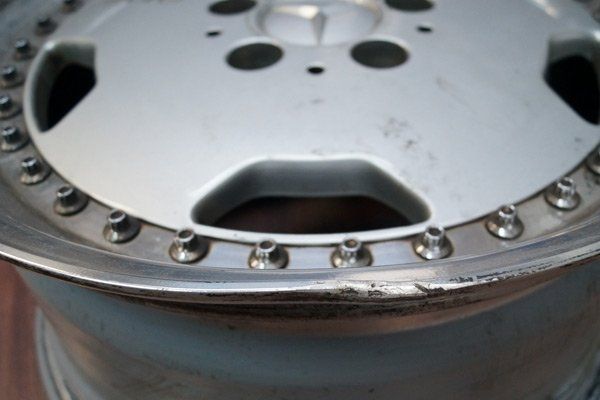
A slight wandering of the steering wheel, a feeling as if the car were running restlessly to one side: often a wheel with lateral run-out is behind it. Unlike classic radial run-out, this damage does not show itself through an up-and-down movement but through a sideways irregularity in the way the wheel runs. This article explains how lateral run-out develops, how to recognise it and which repair options come into question.
What does lateral run-out mean on a wheel?
With lateral run-out the wheel no longer runs in exactly one plane; it wanders minimally sideways as it turns. People also say the wheel wobbles sideways. The difference from radial run-out lies in the direction of the deviation: with lateral run-out the irregularity runs across the direction of travel, not in the height. Even small deviations in the millimetre range are enough to have a noticeable effect on steering behaviour and ride comfort, especially at higher speeds.
Since both types of damage produce similar symptoms but call for different causes and test methods, a direct comparison helps:
| Characteristic | Lateral run-out | Radial run-out |
|---|---|---|
| Direction of the deviation | across the direction of travel | in the height of the wheel |
| Typical cause | sideways contact with a kerb | impact against a kerb or pothole from the front |
| Noticeable driving behaviour | steering wheel “wanders” sideways | even shudder in the steering wheel |
| Noticeable from a speed of | approx. 60 to 80 km/h | approx. 80 km/h |
| Test method | dial gauge lateral to the plane of the wheel | dial gauge in the circumferential direction |
Both types of damage can normally be corrected with the same process. What matters is that the workshop distinguishes between the two forms during the diagnosis instead of simply assuming an imbalance.
How does lateral run-out develop?
The most common cause is a sudden, sideways impact. Typical triggers are:
- sideways contact with a kerb when parking or turning
- running onto an edge at an angle at higher speed
- a hard knock against an obstacle at the roadside
- material fatigue on older, heavily used wheels
Kerb damage is not always visible. The wheel can look unremarkable from the outside and still be slightly deformed structurally. That is exactly what makes a purely visual inspection unreliable.
How do you recognise lateral run-out?
Not every irregularity while driving automatically means the wheel is affected. Typical indications are:
- The steering wheel feels as if it is “wandering” sideways rather than vibrating evenly.
- The effect gets stronger as the speed rises.
- There is no additional braking noise that would point to another component.
- The tyre shows no visible bulge or deformation.
If these points apply, there is a lot to suggest that the wheel is not running true and that an inspection is necessary. A reliable answer, however, comes only from the workshop, not from a subjective impression at the wheel.
Checking run-out: how the diagnosis works
To establish lateral run-out reliably, the wheel is checked on the lift. With the classic method a dial gauge measures the sideways deviation while the wheel turns. In addition, a balancing machine can determine whether an imbalance is the actual problem, a defect that is frequently confused with run-out but is technically different.
Modern businesses also use 3D laser measurement, which records the complete geometry of the wheel and delivers more precise values than a purely manual check. That is important in order to distinguish between damage that can be corrected well and structurally critical deformation. At Mainhattan-Wheels that is the wheel inspection with 3D laser measurement.
Repairing lateral run-out: what are the options?
Whether a wheel can be straightened depends on the extent of the deformation.
Slight to moderate lateral run-out
In most cases the wheel can be straightened at a specialised workshop. The deformation is corrected in a targeted way until run-out is once again within the permissible tolerance.
More severe deformation
With deeper structural damage, straightening is no longer a safe option. Here replacement is the safer choice, because otherwise the load capacity of the material can no longer be guaranteed. No blanket statement can be made without a technical inspection; what counts is the precise measurement and assessment of the wheel.
What does repairing lateral run-out cost?
The cost depends first and foremost on how far the wheel actually deviates from the ideal plane. A pure run-out repair, in other words pushing the deformation back in a targeted way, costs between €80 and €150 per wheel at most specialist workshops. At Mainhattan-Wheels run-out repair costs €150 per wheel incl. VAT, including the inspection and the subsequent correction (see price list).
If the painted surface is damaged as well, for example by the impact itself, the cost of painting or powder coating is added. The total price on the market is then usually between €250 and €400 per wheel. With badly deformed or cracked wheels, replacement is often the more economical decision, because repeated rework ends up costing more than a new wheel.
Conclusion
Lateral run-out is often not apparent at first glance, but it makes itself clearly felt while driving. Anyone who notices a sideways wandering in the steering wheel should have the cause checked promptly instead of ignoring the problem. In most cases the wheel can be straightened without a new purchase being necessary. What matters is a proper check of the run-out before deciding on the right repair method.
Frequently asked questions
What is lateral run-out on a wheel?
The wheel no longer runs in one plane but wanders minimally sideways as it turns.
How does lateral run-out differ from radial run-out?
Lateral run-out runs across the direction of travel, radial run-out in the height of the wheel.
Can a wheel with lateral run-out be repaired?
Yes, usually. Only with severe deformation is replacement the safer choice.
How is lateral run-out measured?
On the lift with a dial gauge, and in modern workshops additionally by 3D laser measurement.