

How long does a professional wheel refurbishment really last?
Realistic durability for wet paint, powder coating, CNC diamond cutting and high-gloss compaction, which factors decide it in the workshop and what shortens it in daily use.
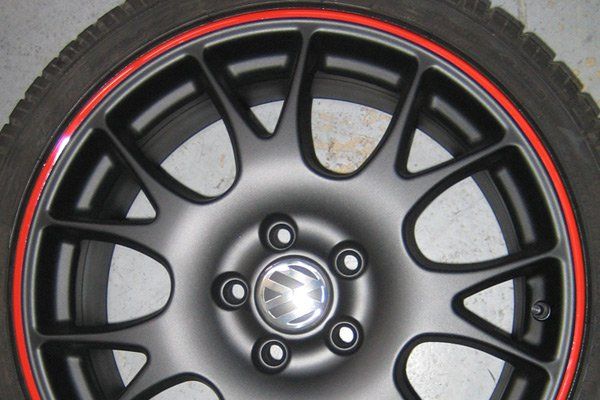
“Will that last several years?” Customers ask this in specialist workshops almost every day. The honest answer: it depends. Not on the wheel, not on the vehicle, but on what happens before, during and after the refurbishment. A professionally executed refurbishment lasts several years. A badly prepared one, no matter how good the result looks at first glance, often does not last twelve months. This article shows which factors determine durability and what quietly shortens it in everyday use.
Realistic timescales by process
Blanket statements do not help here. Durability depends directly on the process used.
| Process | Realistic durability | Requirement |
|---|---|---|
| Wet paint | 2 to 4 years | correct primer, no residual moisture |
| Powder coating | 5 to 10 years | complete stripping, curing in the oven |
| CNC diamond cutting with clear coat | 3 to 6 years | precise machining, clear coat seal |
| High-gloss compaction | 5 to 8 years | regular care absolutely essential |
These figures only apply under one condition: the preparation was done correctly.
What determines durability in the workshop
Most drivers believe durability depends on the paint chosen. That is only half the truth.
1. Surface preparation
The single most important factor. An aluminium wheel forms an oxide layer within minutes. If this is not removed completely, no coating will adhere in the long term, however high-quality the paint may be. Correct preparation means: complete chemical stripping, glass bead blasting, chemical pre-treatment and drying. Anyone who cuts this step short produces a refurbishment with an expiry date.
2. Coating thickness
Paint applied too thinly loses its corrosion protection quickly. Below 60 µm of film thickness, a powder coating can hardly be expected to have any long-term effect. Professional businesses check the film thickness after curing, cheap providers often do not.
3. The curing process in powder coating
Oven temperature too low, curing time too short, and the powder coating does not cross-link fully. The result looks identical but is mechanically unstable and reacts sensitively to temperature changes and load.
What shortens durability in daily use
This is where the real problem lies, and it has to do with the vehicle owner, not the workshop.
Incorrect cleaning
Pressure washer straight onto the wheel, aggressive wheel cleaners with an acid content, hard brushes: all of that attacks the surface. On diamond-cut wheels in particular it is devastating. The characteristic light edge disappears, the clear coat goes matt. The right approach is pH-neutral wheel cleaners, soft microfibre cloths and no direct jet onto freshly painted wheels.
No corrosion protection after the refurbishment
A wheel sealant is not an optional extra but active protection against road salt, brake dust and moisture. Without it, environmental influences work directly against the coating. Ceramic sealants last up to 5 years and are heat-resistant enough for the brake area.
Ignoring mechanical damage
A new scratch or kerb knock on freshly refurbished wheels sounds like a small problem. It is not. Every break in the protective layer is an entry point for corrosion. Anyone who does not deal with it promptly will see the damage spreading under the surface within months.
Winter driving without preparation
Road salt is the greatest enemy of any wheel coating. Anyone who has alloy wheels refurbished and then does nothing about winter care shortens their durability considerably. A sealant before winter and regular cleaning during the salt season make a measurable difference.
What makes a wheel refurbishment last
The difference between a refurbishment that lasts three years and one that lasts seven does not lie in the material alone. It lies in the combination of
- complete stripping as the starting point,
- correct pre-treatment of the aluminium surface,
- a controlled curing or drying process,
- a final sealant to protect the surface,
- clear care advice for the vehicle owner.
Mainhattan-Wheels handles the entire process, from damage analysis through stripping to the finished surface, with a documented workflow designed for long-term results. More on this under Quality.
Conclusion
A professional wheel refurbishment, carried out correctly, easily lasts five years and more. What destroys it prematurely is rarely external influences alone. Usually it is mistakes in the preparation or a lack of care afterwards. Anyone wanting to maximise durability should watch three things: choose the right business, insist on a sealant and clean the wheels regularly and correctly.
Frequently asked questions
How long does a professional wheel refurbishment last?
Depending on the process, between 2 and 10 years. Powder coating lasts the longest, up to 10 years with correct preparation and regular care.
What destroys durability fastest?
The wrong cleaning products, a missing sealant and untreated new scratches are the most common causes of premature wear.
Do you need a sealant after a wheel refurbishment?
Yes. It actively protects the new surface against salt, brake dust and moisture, especially in winter.
Is a wheel refurbishment worth it on older vehicles too?
Yes, as long as there is no structural damage. A good refurbishment considerably extends the life of the wheel and is almost always cheaper than new wheels.