

Why powder coating flakes off some wheels after six months
A correctly executed powder coating lasts 5 to 10 years. When it flakes off early, the cause is almost always the preparation: oxide layer, curing temperature, damaged substrate or too thin a coat.
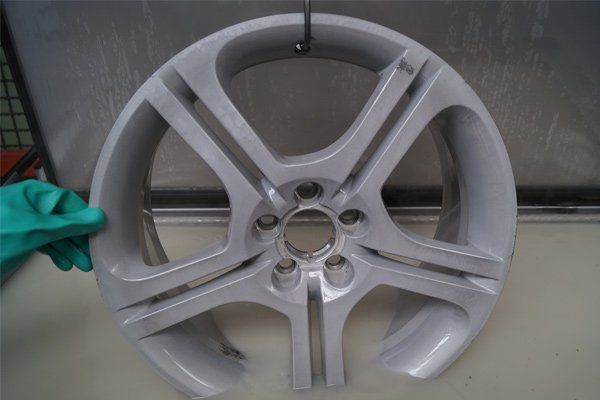
Powder coating is regarded as one of the toughest surface solutions for wheels there is: resistant to stone chips, UV radiation and corrosion, and considerably more durable than conventional wet paint. And yet it keeps happening: the coating flakes off. Sometimes after a year, sometimes after only a few months. The fault almost never lies with the material, but with what happened before curing.
Why a powder coating should not flake off at all
Carried out correctly, a professional powder coating lasts between 5 and 10 years, even with intensive use, winter salt and daily town traffic. The process itself is technically mature:
- The powder coating is applied electrostatically to the wheel.
- It is then cured in the oven at 160 to 200 °C.
- The resulting layer bonds chemically with the substrate.
- The film thickness is typically 60 to 120 µm.
The result is not a layer stuck on top but a cured bond. If it nevertheless fails, the fault lies in the process.
The most common causes of early failure
1. Inadequate surface preparation
This is by far the most common cause. Aluminium wheels form a natural oxide layer within minutes. If this is not removed completely, the powder coating does not adhere to the base metal but only to the oxide layer. And that lets go sooner or later. Correct preparation means:
- complete chemical stripping of the old coating in an immersion bath
- gentle glass bead blasting to remove oxide and corrosion residues
- phosphating or chromating as a key
- drying before the powder is applied
Anyone who skips or cuts short one of these steps risks exactly that: a coating that flakes off after months.
2. The wrong curing temperature or time
Too low an oven temperature and the powder coating does not cross-link fully. The result looks good but is mechanically unstable. Too high a temperature and the aluminium loses strength while the layer becomes brittle. Both lead sooner or later to paint damage and flaking patches.
3. Coating over a damaged substrate
A common mistake at cheap providers: the wheel is coated without checking the condition of the base metal. Micro-cracks, porosity or areas that are already oxidised are simply covered over. What lies underneath keeps working and sooner or later pushes the coating off from within.
4. Too thin a film
Below 40 µm of film thickness the coating loses much of its protective effect. Mechanical stress from stone chips, wheel brushes or temperature swings is then enough to damage the surface.
How do you spot a poor powder coating?
| Feature | Quality coating | Poor execution |
|---|---|---|
| Surface | even, no pores | orange peel, inclusions |
| Adhesion | firm, no blisters | lifting at the edges |
| Film thickness | 60 to 120 µm | below 40 µm |
| Gloss after one year | stable | faded, matt |
| Edges | cleanly coated | visible corrosion creeping under |
The difference in quality often shows first at the rim edges. That is where the layer is thinnest, and where poor work starts to fail first.
What has to be done before coating
Before any powder is used at all, the surface preparation decides everything. A structured process looks like this:
- Complete stripping: remove the old coating without residue
- Glass bead blasting: eliminate the oxide layer and contamination
- Chemical pre-treatment: create the key for the powder coating
- Visual inspection: check the base metal for cracks, pores and damage
- Drying: no residual moisture before curing
- Powder application and curing: hold the correct temperature and time
Every one of these steps is necessary. Anyone who treats one of them as optional produces a coating that will fail sooner or later. That is why Mainhattan-Wheels works with a fully controlled process, from stripping to the finished powder coating, and checks the condition of the base metal before any refurbishment begins.
Conclusion
A powder coating that flakes off after a few months is not a material fault but a process fault. Inadequate pre-treatment, incorrect curing temperatures and overlooked damage to the base metal are the three most common causes. All three are avoidable if the business knows what it is doing. Anyone who wants results that last should look not for the cheapest provider but for the most structured process.
Frequently asked questions
Why does powder coating flake off wheels?
Almost always because of poor surface preparation: no stripping, an oxide layer that was not removed or the wrong key before curing.
How long does a professional powder coating on wheels last?
With correct execution and normal use, between 5 and 10 years.
Can flaked powder coating be repaired?
No, a local repair is not possible. The wheel has to be stripped and coated again completely.
What does a new powder coating cost after it has flaked off?
On the market, between €120 and €250 per wheel depending on size and condition, plus stripping and preparation. At Mainhattan-Wheels the fixed price of €175 per wheel incl. VAT from the price list applies.